


The following Research paper was written as part of my third-year Master of Divinity studies at Emmanuel College, for KNH2010: History of Christianity II
Introduction
Few female figures in Christian medieval history stand out with quite the same eccentric charisma and creative force as the twelfth-century visionary Hildegard of Bingen. Over the course of her eighty two year long life, Hildegard gained quite the reputation, achieving celebrity status among monastics, clerics, and laypeople alike. She was an author, composer, musician, abbess, herbalist, theologian, preacher, political advisor, and prophetess. Her body of work is substantial and diverse, encompassing theological and moral treatises, visionary writings, musical compositions, a “morality play”, the creation of a new language, and even a compilation of natural remedies and cures.
While it could be argued that Hildegard’s legacy touches many facets of medieval theology and culture, this paper will focus on how her claims to divine revelation challenged prevailing religious beliefs and practices, particularly within the established church and monastic hierarchies to which she herself belonged. It will be argued that Hildegard of Bingen challenged the medieval Church’s monopoly on spiritual authority by asserting divine revelation as a source of truth equal to, and at times above, ecclesiastical authority. Through her visionary theology, creative output, and persuasive feminine leadership, she expanded the boundaries of what was possible for female mystics and visionaries, legitimizing women’s voices as bearers of divine wisdom both within and beyond monastic confines.
Hildegard’s Life
According to Augustine Thompson, Hildegard of Bingen is best known as “a visionary prophetess”. Born in 1098 in the diocese of Mainz in the Holy Roman Empire (modern-day Germany), she was the tenth child of noble parents. At the age of five, Hildegard experienced her first vision of what she would later call “the living light” – a dazzling brilliance that initially terrified her. Soon after, she astonished a member of her household by accurately predicting the color and markings of a calf before it was born. It was not long before she realized that other children did not see as she did, and thus she would wait many decades before speaking openly about her visions, despite continuing to experience them throughout her life.
Hildegard’s hagiography (hereafter Vita) states that her parents offered her to the church as a dedication to God when she was eight years old. Barbara Newman suggests that Hildegard’s early reports of visionary experiences may have influenced her parents’ decision, as the unusual nature of their daughter’s spiritual gifts were better suited for life in the cloister than for marriage. Hildegard was also a “sickly” child, experiencing frequent bouts of illness that she later understood to be linked to her visionary states. In any case, Hildegard seems to have embraced monastic life. She was entrusted to the care of the recluse Jutta of Sponheim, who was quickly gaining a local reputation for piety and holiness.
Jutta, Hildegard, and a third woman who served as their attendant lived enclosed as anchoresses within the Benedictine monastery of Disibodenberg. As Honey Meconi notes, in twelfth-century monasticism, and particularly within the diocese of Mainz, it was not unusual for anchoresses to reside within a male monastery. The presence of such virgin hermit women brought spiritual prestige and financial gifts to the male community, while the seclusion of their cell was believed to foster “the better practice of spiritual piety.” While living in the enclosure, Jutta taught Hildegard the psalter and instructed her in the pious ways of virgin women living under the Rule of St. Benedict. The rest of Hildegard’s education was entrusted to the monk Volmar, who would become her lifelong companion, confidant, and supporter.
Hildegard had been enclosed for twenty-four years when her mentor Jutta died, and the growing women’s community at Disibodenberg, now numbering ten nuns, unanimously elected Hildegard as their new magistra. Five years later Hildegard experienced a vision unlike any she had known before, an event that would alter the course of her life. She writes:
It happened that, in the eleven hundred and forty-first year of the Incarnation of the Son of God, Jesus Christ, when I was forty-two years and seven months old, Heaven was opened and a fiery light of exceeding brilliance came and permeated my whole brain, and inflamed my whole heart and my whole breast, not like a burning but like a warming flame, as the sun warms anything its rays touch. And immediately I knew the meaning of the exposition of the Scriptures, namely the Psalter, the Gospel and the other catholic volumes of both the Old and the New Testaments, though I did not have the interpretation of the words of their texts or the division of the syllables or the knowledge of cases or tenses.

In this vision God speaks to her directly, imparting knowledge of the scriptures and instructing her to “Speak therefore of these wonders, and, being so taught, write them and speak.” Despite this divine command, Hildegard was weary. The twelfth century was a time in which feminine religious authority was severely limited. Women were expected to be silent, and were explicitly barred from teaching or assuming authority over men (1 Tim 2:12). Her reluctance to obey her visionary call soon manifested in a severe illness. Recognizing her sickness was a consequence of resisting God’s command, she confided in her trusted advisor Volmar, who recognized Hildegard’s gift and urged her to write as she had been instructed. Thus began her first major visionary and theological work: Scivias (which means “Know the Ways of the Lord”), composed with Volmar’s help in shaping her Latin and with the assistance of her beloved nun Richardis von Stade, a learned noblewoman who supported and encouraged her.
It was not long before Volmar approached the abbot of Disibodenberg, Cuno, to begin the formal process of securing ecclesiastical approval for Hildegard’s writings. At the same time, Hildegard was not content to rely solely on Volmar as her male advocate. She took the extraordinary step of writing directly to the most renowned monastic figure of her day: the Cistercian monk Bernard of Clairvaux. The ever-strategic Hildegard wrote this letter knowing full well it would be publicly circulated and thus read by many. As such, the letter served a dual purpose: it genuinely sought Bernard’s counsel, a figure whom she deeply admired, addressing him as “gentle father” and “most praiseworthy”, and it publicly announced the existence of her visions to others who might support her. Bernard, who was known to favour experiential wisdom over scholastic learning, replied favourably, assuring her that “God’s grace was in her and she should respond to it.”
Around the same time, Abbot Cuno brought Hildegard’s writings to the Archbishop of Mainz, who then brought the matter before Pope Eugenius III: a Cistercian and former disciple of Bernard of Clairvaux. The Pope sent a commission to Disibodenberg to interview Hildegard and obtain a copy of her work, portions of which he is said to have read publicly at the Synod of Trier. According to Hildegard’s Vita, Bernard of Clairvaux was present at the synod and urged his former disciple, now Pope, to approve Hildegard’s writings. The Vita further claims that Eugenius responded by sending Hildegard a letter of approval and offering congratulations to Abbot Cuno. As Meconi notes, these details of papal approval through Bernard’s intervention are likely fabricated by Hildegard’s hagiographers. Even so, there is no evidence that the Pope required Hildegard to halt her work. It can therefore be assumed that there was, at minimum, “a tacit approval of her activity.”
After the Synod of Trier, Hildegard’s fame quickly grew and increasing numbers of noble families sent their daughters to join her community at Disibodenberg. As such, the women’s quarters soon became overcrowded. In the midst of this strain, Hildegard received another significant vision, this time revealing a solution to the community’s cramped conditions. She saw “a place where the river Nahe flows into the Rhine, a hill dedicated in days of old to the name of St. Rupert the Confessor.” Hildegard understood this as the divinely appointed site for her women’s community.
This episode marks one of the first instances in which Hildegard’s claim to divine revelation directly challenged, and even sought to override male ecclesiastical authority. Abbot Cuno strongly opposed the relocation of the women’s community. The nuns brought not only spiritual prestige but also substantial financial benefits to Disibodenberg: each noble daughter entered with a dowry, and many lay patrons offered generous gifts in recognition of Hildegard’s presence. Beyond these considerations, there was also the practical matter of securing and cultivating the land at Rupertsberg, owned by other parties. Some of the monks began to question Hildegard’s visionary claim. Was it truly a divine command, or merely the expression of Hildegard’s personal will? If the latter, her wishes could not legitimately override ecclesiastical authority.
Hildegard, as was often the case, responded physically to the conflict by falling gravely ill, so weak that she could not walk. Witnessing her condition, and perhaps influenced by intervention from the Archbishop Heinrich of Mainz and other members of the nobility who favoured Hildegard, Abbot Cuno finally relented, acknowledging that Hildegard’s vision was indeed God’s will. Hildegard rose from her bed upon receiving Cuno’s consent, and after countless interventions from the noble families of her monastic daughters (as well her own noble family) to secure the property, in 1150 the women’s community officially moved to the new convent at Rupertsberg, close to the town of Bingen.
The early years at Rupertsberg were to prove difficult. It would take five years for Hildegard to secure financial independence from the male community at Disibodenberg. During this time, some of her nuns left the community, including her favourite disciple Richardis von Stade who was appointed Abbess at another convent, much to Hildegard’s dismay. Tragically Richardis died a year later, reportedly regretting her decision to leave Hildegard. Despite these challenges, Hildegard persevered, and after eight years of struggle, the Archbishop of Mainz granted her community formal protection, regulating the “temporal and spiritual relations” between Rupertsberg and the male monastics at Disibodenberg with whom Hildegard had long been at odds. Thus, at the ripe age of sixty, Hildergard began the next chapter of her life: the writing of her second book on virtues and vices (The Book of Life’s Merits), and the commencement of her preaching tours.
For a female monastic to embark on preaching tours outside the convent was virtually unheard of in the twelfth century. Yet no one stopped Hildegard. Her fame had only continued to grow due to her prophetic visions, and she had become a respected spiritual advisor to influential political and ecclesiastical figures throughout the Holy Roman Empire – including Emperor Frederick Barbarossa, who in 1163 granted her community imperial protection “in perpetuity.” Hildegard had become, in many respects, untouchable.
Her preaching style was bold and prophetic, delivered by a self-described “poor little figure” of a woman who had “no claim to learning or courage,” yet chastised bishops and priests all the same for their “easy living.” Her message and tone echoed that of the biblical prophets, calling the Church to repentance and reform. Hildegard insisted that this message came directly from the “shadow of the living light”, the radiant divine source of all her visionary experiences. Her warnings and exhortations were widely received, their resonance likely strengthened by the growing unrest and uncertainty surrounding the Papal Schism of 1159-1177.
Despite this bold prophetic preaching style, Hildegard exercised a certain caution. She rarely addressed specific situations directly, instead favouring broader interpretations that could be applied in multiple ways and across a variety of contexts. Even when clearly alluding to the schismatic actions of Emperor Frederick Barbarossa, for example, the same ruler whose favour she had secured and who had granted her community protection, she refrained from naming him outright. Still, Hildegard made her position clear. After Frederick supported a second anti-pope and thus prolonged the schism, she wrote him a scathing letter that admonished him as “a little boy” who had acted as though he had “lost his mind.” In doing so, Hildegard demonstrated a certain fearlessness in confronting both religious and political authorities when her visions demanded it.
And while Hildegard’s visions articulated a largely orthodox theology, the authority she gained from them enabled her to push against ecclesiastical boundaries in other ways. One example concerns her approach to female adornment. Hildegard permitted her nuns to wear their hair unbound on feast days, adorned with jewellery and golden crowns, and draped in long white silk garments that trailed to the floor. This practice was so controversial that an abbess from another convent wrote to rebuke her. Hildegard responded with her characteristic confidence, defending her choice on the grounds of divine revelation: she had seen such attire in a vision, and since her nuns were virgins it was appropriate that they honour God through their beauty.
The final major conflict of Hildegard’s life unfolded in 1178 and was only resolved six months before her death in 1179, bringing her once again into direct confrontation with her male superiors. By this time, Hildegard had completed her third major visionary-theological work Liber divinorum operum (Book of Divine Works), alongside numerous other writings: scriptural and theological commentaries, a medical manual, musical compositions, and hundreds of letters. She had performed a widely known and successful exorcism and had undertaken four preaching tours. Her longtime monastic confidant Volmar had died, and she was now assisted by the monk Guibert of Gembloux, a devoted admirer whom Meconi calls “the last significant male figure in her life.”
The conflict arose when Hildegard permitted a man who had previously been excommunicated to be buried in the cemetery of her convent. Although church law forbade the burial of excommunicates on consecrated ground, Hildegard believed the man had repented before death and was therefore absolved. The authorities of the Mainz diocese, however, maintained that he remained under excommunication and ordered Hildegard to exhume the body. She refused, declaring that her visions forbade her from disturbing the grave, and even took measures to hide the grave. In retaliation, the diocese placed her community under interdict.
For Hildegard, the interdict was profoundly distressing. Monastic communities existed to “fulfill the opus Dei” – the continuous praise of God through sung liturgy, and this interdict included a liturgical ban. This was especially grave for someone like Hildegard, a gifted composer whose works Guibert of Gembloux described as “far more pleasing than ordinary human music.” In addition to this ban, Hildegard and her nuns were denied the Sacrament of Holy Communion. Though she obeyed the interdict, she did so with “great sorrow” and immediately began writing to her influential noble and ecclesiastical allies, culminating in a bold letter to the Archbishop of Mainz. In this letter she explicitly references her vision of the “Living Light”, insisting that as a prophetess she was commanded by God to “compose songs and canticles by which the hearts of listeners would be inflamed” and that an unjust interdict was the work of the devil. Supported by both the divine authority of her visions and the intervention of the Archbishop of Cologne, Hildegard’s position was eventually vindicated: the Archbishop of Mainz conceded under pressure and lifted the interdict. Thus Hildegard won the final great battle of her life, once again through the spiritual authority she derived from her visionary experiences, and through the network of powerful supporters those visions had helped her cultivate.
Hildegard’s Visions in Context
Thus far, we have seen how Hildegard’s claim to divine revelation repeatedly challenged, and at times even overrode ecclesiastical authority throughout her life. Yet to appreciate the full extent of her impact, her visions must be situated within the broader landscape of twelfth-century monasticism and the shifting currents of medieval mysticism.
The twelfth century was a period marked by intense religious fervour. Monastic communities flourished during this time – not only the older and more established orders such as Hildegard’s Benedictines, but also the newer reformed communities like the Cistercians (the order of Bernard of Clairvaux) and the Cluniacs. As Bernard McGinn notes, these communities represented the classical ideal of “flight from the world,” in which one pursued a “specialized life of penance and prayer” either as a hermit or within a cenobitic community. Yet the broader landscape of medieval mysticism was changing. McGinn observes that the twelfth century functioned both as the “summation of traditional monastic mysticism,” and as the seedbed of a new form of Christian mystical expression, one increasingly active and oriented toward the world, a development that would come to fuller maturity in the thirteenth century and beyond.
Alongside these broader shifts, the twelfth century also witnessed a notable rise in visionary activity, anticipating the “visionary explosion” that would characterize the centuries to come. Hildegard was neither the first nor the only female visionary of her era, yet she quickly emerged as its most prominent figure, distinguished by the theological sophistication, scope, and prophetic force of her visions, alongside her astounding creative output. Further insight into the unique nature of Hildegard’s visionary activity can be found in her correspondence with Guibert of Gembloux, where she writes as follows:
I do not hear them with my outward ears, nor do I perceive them by the thoughts of my own heart or by any combination of my five senses, but in my soul alone, while my outward eyes are open. So I have never fallen prey to ecstasy in the visions but I see them wide awake, day and night…
The light which I see thus is not spatial, but it is far, far brighter than a cloud which carries the sun. I can measure neither height, nor length, nor breadth in it; and I call it “the reflection of the living Light”…
Moreover, I can no more recognize the form of this light than I can gaze directly on the sphere of the sun. Sometimes—but not often—I see within this light another light, which I call “the living Light.” And I cannot describe when and how I see it, but while I see it all sorrow and anguish leave me…
At no time is my soul deprived of that light which I call the reflection of the living Light, and I see it as if I were gazing at a starless sky in a shining cloud. In it I see the things of which I frequently speak, and I answer my correspondents from the radiance of this living light.
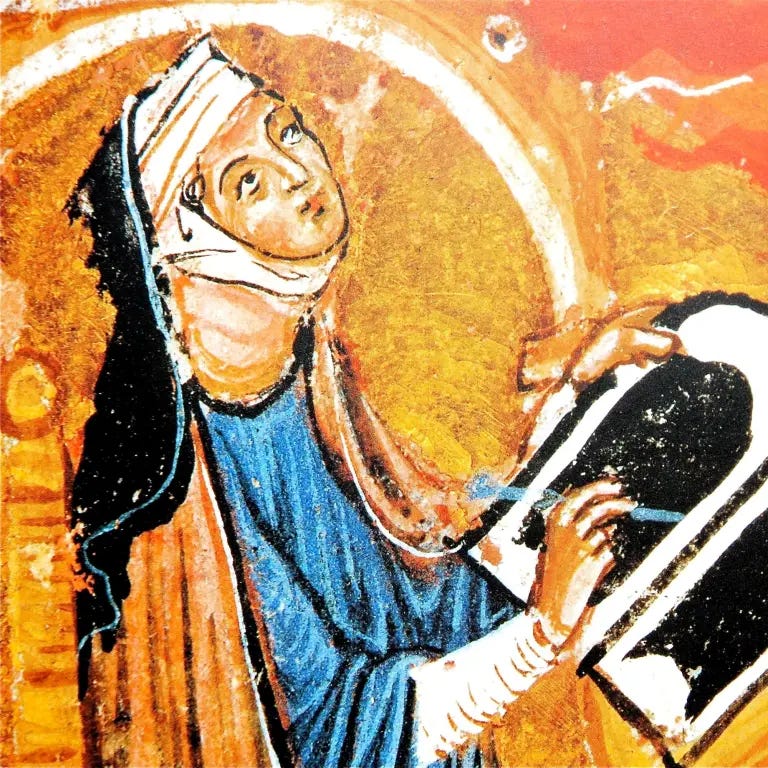
What Hildegard describes in this correspondence differs considerably from the visionary patterns of her contemporaries. Twelfth-century Benedictine theologian Rupert of Deutz (1075–1129), for instance, experienced two major sequences of visions, all of which came to him through dreams. Elisabeth of Schönau (1129–1165), who openly admired Hildegard and consciously modeled herself after her, often entered ecstatic trances while receiving her revelations. By contrast, Hildegard was “wide awake” when she received her visions, perceiving them not in ecstasy, but through a continuous inner radiance. Thus, Hildegard became the prototype; her unique mode of revelation combined with her esteemed reputation meant that “later visionaries and their authorizers could cite her as an example.”
It is no coincidence then, that the golden age of female medieval mysticism began to flourish in the thirteenth century, shortly after Hildegard’s death. Hildegard was arguably a catalyst for this shift, a visionary who helped inaugurate a new era of feminine authority which became increasingly bold, embodied, and at times erotic in its mystical devotion. Yet such authority for women was often contingent upon the protection of respected male advocates within the ecclesiastical hierarchy. Hildegard herself benefited from this dynamic: first through the steadfast support of Volmar, and later through powerful allies such as Bernard of Clairvaux, Archbishop Heinrich of Mainz and Frederick Barbarossa. Female visionaries or mystics who lacked such protection often faced devastating consequences. The beguine Marguerite Porete, for example, was executed for her Mirror of Simple Souls in 1310, a text condemned as heretical for its theology of “annihilation” of the soul in God, and, crucially, for circulating without male clerical endorsement.
Hildegard’s visions, by contrast, articulated a thoroughly orthodox theology: one that aligned with church doctrine even as it subtly expanded its boundaries (particularly around gender) in ways sophisticated enough to avoid question. As Emilie Schulze notes, adherence to “belief in the incarnation, atonement, and resurrection of Christ” was essential to orthodoxy. Hildegard not only affirmed these doctrines but elaborated upon them in great depth, even expressing them through her musical compositions. She also openly opposed the Cathars, the major heretical movement of her day, aligning herself unmistakably with the institutional church. Yet Hildegard’s orthodoxy did not prevent her from pushing boundaries or challenging ecclesial authority, as her prophetic preaching and conflicts with her male superiors demonstrate. Just how, then, did she manage to transgress these boundaries while emerging not only unscathed, but celebrated? The key lies in the strategic, even subversive, ways she reinforced the authority of her visions.
Hildegard’s visionary compositions, whether writing theological treatises, refuting heresies, or composing music were so comprehensive in scope and intellectually compelling that they rivalled, and arguably even surpassed, the work of male, university-trained master theologians. Hildegard’s male superiors and the ecclesiastics who came in contact with her work could not fathom that such a comprehensive theology and “sound doctrine” might originate from a woman, being of the gender that was overwhelmingly viewed as the intellectually weaker sex. For many ecclesiastics, it was simply inconceivable that a woman could produce such sophisticated theology without divine revelation. Hildegard’s appeal to visionary authority thus became, for them, the only logical explanation.
Hildegard herself fully embraced this rationale, whether consciously or unconsciously. Despite several modern scholars citing substantial evidence that she was more learned than she claimed, she leaned into the trope of feminine weakness, repeatedly emphasizing her lack of formal education and her frequent physical illnesses, all of which worked to bolster her claim that everything she wrote and spoke came from divine revelation. This claim aligned seamlessly with scriptural reversals of power and with the flourishing Marian devotion of the twelfth century. Not only did Hildegard draw upon biblical reversals such as “the humble shall be exalted” (Matt. 23:12) and “God chose the weak things of the world to shame the strong” (1 Cor. 1:27), but many began to explicitly compare her to the Virgin Mary, which only strengthened Hildegard’s spiritual authority. Guibert of Gembloux, responding to Hildegard’s letter about her visions, declared that no woman “since the Virgin Mary had received so great a gift from God,” and that Hildegard had “transcended female subjection by a lofty height and is equal to the eminence not of just any men but of the very highest.” Similarly, the white monks of Villers addressed her with the salutation, “Hail, after Mary full of grace: the Lord is with you!” Thus, Hildegard became a new Marian prototype; a woman of the “weaker sex” who, through humility and divine favour, was elevated to extraordinary spiritual authority.
Hildegard’s Legacy
As the landscape of medieval mysticism evolved in the thirteenth century and beyond, so too did the legacy of Hildegard’s life and visionary work. Although her musical compositions faded into obscurity in the centuries following her death, her writings continued to circulate widely, translated into vernacular languages and read by both male and female visionaries across Europe. Her influence was especially significant for later women visionaries in the Holy Roman Empire, many of whom likely drew directly from her example as a divinely authorized teacher. In 1220, the Cistercian monk Gebeno of Eberbach compiled an accessible anthology of her prophetic visions which was widely read, further cementing her reputation as a legitimate and authoritative bearer of divine wisdom.
Her prophetic voice continued to prove relevant in later centuries. During the Great Western Schism (1378-1417), theologians such as Henry of Langenstein drew heavily on Hildegard’s visions to call for repentance and ecclesial reform, demonstrating the adaptability and perceived reliability of her revelations. This pattern of referencing Hildegard’s prophetic visions during times of crisis continued during the Protestant Reformation, when both sides of the conflict used her warnings against corruption to legitimize their competing narratives. As Anderson notes, “whether Protestant or Catholic, it seemed, each reader felt Hildegard’s visionary critique of the church was on his side.”
Conclusion
Hildegard of Bingen stands out as a remarkable twelfth-century figure whose life and work challenged the medieval Church’s singular claim on spiritual authority. By grounding her theological, creative, and prophetic output in a continuous mode of divine revelation, she asserted a source of truth that paralleled, and at times superseded, the institutional hierarchies in which she lived. Unlike many female mystics who came after, Hildegard’s visions were never merely private encounters between the soul and God; they functioned as authoritative interventions into the religious and political life of the Holy Roman Empire, demanding reform, shaping public discourse, and rewriting prevailing assumptions about who could be appointed to speak for God.
Hildegard’s success lay not only in the power of her revelations but also in her strategic understanding of how to present them. By adopting the rhetoric of feminine weakness, illness, and humility, she aligned herself with biblical reversals and the growing wave of Marian devotion. This allowed supporters to interpret her authority as divinely sanctioned rather than transgressive, enabling her to cultivate a network of influential allies who reinforced her spiritual legitimacy. Her authority also extended well beyond her lifetime. The continued circulation and reinterpretation of her writings throughout the Middle Ages reveal how profoundly her voice resonated with later generations navigating ecclesial turmoil and reform.
Ultimately, Hildegard of Bingen expanded what was possible for women within the medieval Church. By demonstrating that divine revelation could authorize a woman to write, teach, advise, admonish, and lead, she secured not only her own influence but also opened new pathways for the female visionaries who followed her. In claiming revelation as a source of truth equal to institutional authority, Hildegard reshaped the landscape of medieval spirituality and left an enduring legacy as one of the most authoritative and subversive visionary voices of the Middle Ages.
Bibliography
Anderson, Wendy Love. “The Context and Reception of Hildegard of Bingen’s Visions.” In The Cambridge Companion to Hildegard of Bingen, edited by Jennifer Bain, 189–206. Cambridge Companions to Literature. Cambridge: Cambridge University Press, 2021.
Athanasiadis, Hannah. “Contemplating the Patterns of Love’s Growth through the Lens of Marguerite Porete and Teresa of Avila.” Unpublished manuscript, EMT2001H: Eros and Spirituality, April 11, 2024.
Ginther, James. “Hildegard of Bingen’s Theology.” In The Cambridge Companion to Hildegard of Bingen, edited by Jennifer Bain, 85–104. Cambridge Companions to Literature. Cambridge: Cambridge University Press, 2021.
Gottfried of Disibodenberg, and Theodoric of Echternach. The Life of the Saintly Hildegard. Translated by Hugh Feiss, OSB. Toronto: Peregrina Publishing Co., 1996.
Hildegard of Bingen. Scivias. Translated by Mother Columba Hart and Jane Bishop. Introduced by Barbara J. Newman. Preface by Caroline Walker Bynum. The Classics of Western Spirituality. Mahwah, NJ: Paulist Press, 1990. http://dx.doi.org/10.5040/9780809171309.
Hildegard of Bingen. The Book of Divine Works: With Letters and Songs. Edited and introduced by Matthew Fox. Translated by Robert Cunningham. Letters translated by Ronald Miller. Santa Fe, NM: Bear & Company, 1987.
Logan, F. Donald. A History of the Church in the Middle Ages. 2nd ed. New York: Routledge, 2013.
McGinn, Bernard. “The Changing Shape of Late Medieval Mysticism.” Church History 65, no. 2 (June 1996): 197–219. https://www.jstor.org/stable/3170288.
Meconi, Honey. Hildegard of Bingen. Urbana: University of Illinois Press, 2018.
Newman, Barbara. “Hildegard of Bingen: Visions and Validation.” Church History 54, no. 2 (June 1985): 163-175. https://doi.org/10.2307/3167233.
Newman, Barbara. Sister of Wisdom: St. Hildegard’s Theology of the Feminine. Berkeley: University of California Press, 1998. https://doi-org.myaccess.library.utoronto.ca/10.1525/9780520920187
Schulze, Emilie. “Hildegard: A Trailblazer?” Musical Offerings 12, no. 2 (2021): Article 3. https://doi.org/10.15385/jmo.2021.12.2.3.
Thompson, Augustine. “Hildegard of Bingen on Gender and the Priesthood.” Church History 63, no. 3 (September 1994): 349-364. https://www.jstor.org/stable/3167533.